
“Riches and status unjustly attained are to me like floating clouds.”
Confucius
Fashion, e-commerce, China, and millions of dollars in new capital. The Chengdu-based B2C apparel company Milanoo, now backed by Sequoia Capital, appears to occupy all the right spaces for success. In fact, the company boasted that it had 600% yearly growth in revenue since its 2008 inception. Has Sequoia made an e-commerce investment that will take to the sky or, with an in-depth analysis of Milanoo’s SEO tactics, will Confucius yet again prove to be prescient?
“There are no shortcuts,” Sequoia’s China page succinctly states to entrepreneurs. The VC involved in the Milanoo deal, Kui Zhou, didn’t keep to this maxim and, whether intentionally or not, overlooked the tactics used to drive organic traffic to the site. Among the most valuable keywords Milanoo ranks for in Google are “cheap dresses” (position 2), “evening gown” (1), “cheap wedding dresses” (1), and “summer dresses” (2) – those four keywords alone have an equivalent cost of nearly $200,000/mo in AdWords.
How does a small Chinese e-tailor of wholesale apparel, often copied from designer brands, manage to outrank websites like Lord & Taylor (4), Victoria’s Secret (12), Banana Republic (35), and Gap (39) for the keyword “summer dresses”?
Spam and paid links, and lots of them.
Link popularity plays a large part in search engine algorithms to determine if and when a website should rank for a given search query. In combination with many other signals, the more links a website has, the better. Google likens the relationship to a democracy, whereby “sites have been ‘voted’ to be the best sources of information.” Minaloo has rigged this election by buying votes; that is, buying links to both its homepage as well as to individual product pages.
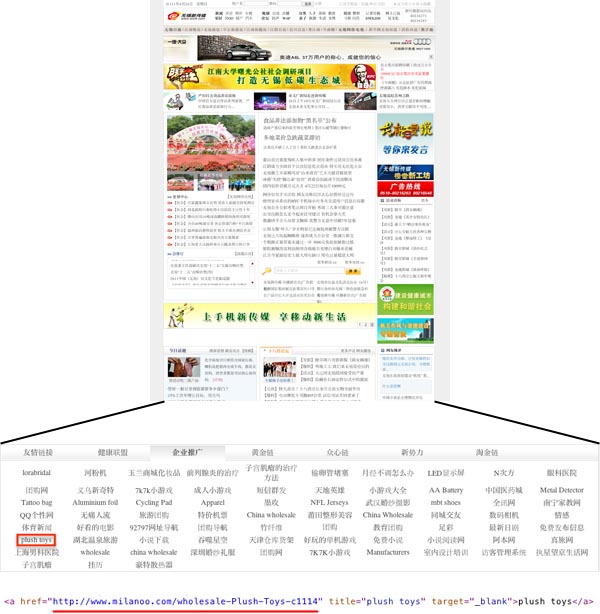
Under the banner of 企业推广, or promoting enterprise, many popular websites in China see it fit to sell links.
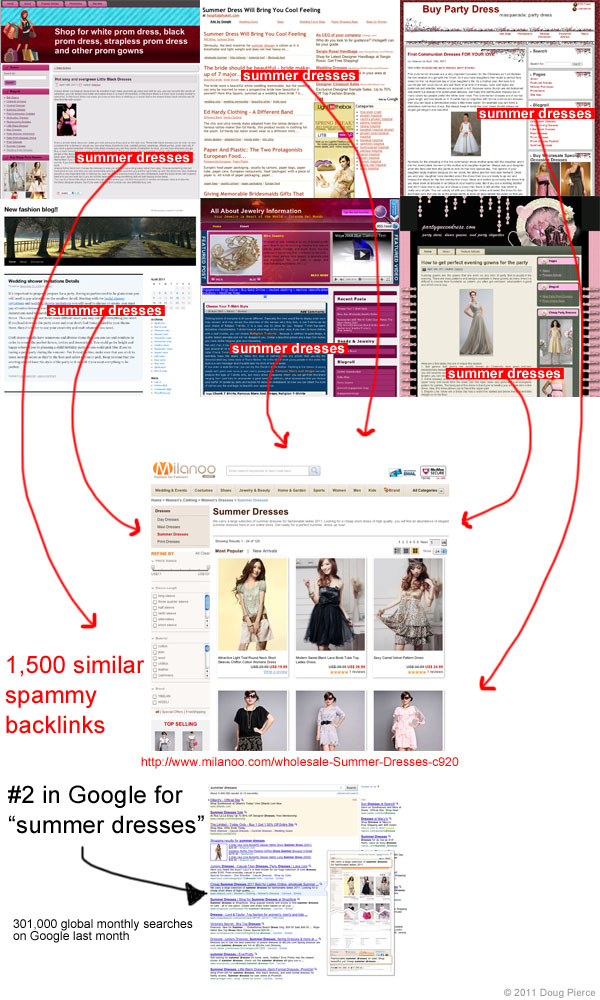
Looking back at the “summer dresses” keyword with the Open Site Explorer tool from SEOMoz, we couldn’t find a single inbound link that points to the page that isn’t spam or paid for. Subtlety wasn’t their strong suit either, as over 90% of the links used the anchor text “summer dresses”. Targeted anchor text is a positive signal that the page being linked to should rank well for those keywords in the anchor text. It’s also unnatural for such a high percentage of sites to link with exactly the same anchor text and not slight variations or overlapping keywords.
“Google is the best,” gushed Milanoo’s founder, Albert Feng, in a recent San Jose Mercury News article. “As soon as I founded my company, I thought of Google.” Sequoia Capital, seeing a growing company with revenue of $16 million a year, didn’t think of Google, specifically whether the tactics used to keep the flow of visitors was sustainable. The risk of penalty by Google could set the company back nearly $1 million a month in AdWords spend to replace lost visits from organic search. Where was the due diligence?

[...] like [cheap dresses] and [evening gown]. They got news of the situation by way of a site called Digital Due Diligence that checked Milanoo’s backlink profile and determined that “we couldn’t find a [...]
[...] couple days ago, this article was published: Sequoia Fails to Spot Milanoo’s Black Hat Tactics Before Investing. It details how a fashion start-up, Milanoo, backed by the most well known Venture Capital firm, [...]
Nice! And they’re still ranking #2 for “evening gown” as of April 29. Apparently Matt Cutts hasn’t read your blog.
Reading through some of the reviews on the clothes is also almost laughable. One woman who ordered a formal gown tells of it arriving with blood stains (guess that working the fingers of employees to the bone is literal, or something) and foot prints, and customer service advising her to wipe it off with a towel. That probably went into the most disgusting category, but in the most common section were lots of reviews from people who received items that looked nothing like (the original) items pictured.
Which isn’t surprising, but designer knockoffs, search spam, and poor customer service combined should have raised an eyebrow somewhere, Particularly since from all of the information I’ve been able to find, the majority of the company’s sales are coming from outside of China.
I haven’t seen any funding announcements, but I’d be surprised if Lightinthebox didn’t have a similar backlink profile as well.
[...] Sequoia Fails to Spot Milanoo’s Black Hat Tactics Before Investing [...]